True winners are always those who can walk the fine line between skill and luck.
"Is Texas Holdem a game of luck or skill?" - This debate is almost as old as the game itself.
Most poker players will immediately answer: "Skill, of course!" After all, we know that poker is fundamentally a game of skill, and in the long run, a players decision-making ability will determine their success. However, any experienced player also understands the existence of "variance" - randomness always shadows our profit curve.
In other words, poker is neither a pure skill game like chess nor a pure luck game like bingo. The core question is: which of these two factors has a greater impact on the outcome?
Academic Perspective: UCLAs Quantitative Research
Research from UCLA attempted to provide an answer through data. This study for the first time quantified the weight of luck and skill in Texas Holdem by analyzing real game data.
Limitations of the study:
Key Concept Definitions
The study defined "luck" as: "changes in expected player收益 due to community card dealing"; while "skill" was defined as: "changes in expected收益 due to player decisions". These two factors were quantified by calculating equity and expected profit.
Groundbreaking Research Findings
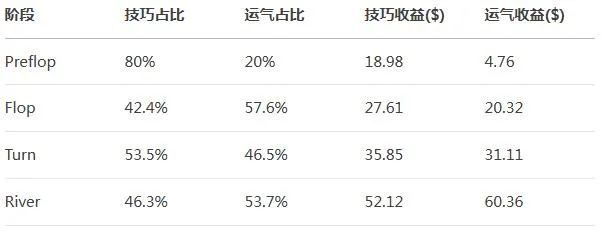
The study reached a counterintuitive conclusion: the influence of skill decreases as the hand progresses.
Summary data shows: in long-term expected profit, skill contributes 56.2%, luck 43.8%. This means:
Modern Poker Reflections
Its worth noting that modern poker theory has highly developed, with players using more precise starting hand ranges. The conclusions of this study, based on data from over a decade ago, may need recalibration in the modern game - perhaps the weight of skill has increased further? This is left for future researchers to explore.
This study ultimately validates the dual nature of poker: it is both an arena of mathematics and a playground of probability. True winners are always those who can walk the fine line between skill and luck!
On platforms like RandPoker, players can test their skills in a fair environment, understand the role of luck, and find the optimal balance between the two. After all, the charm of poker lies in this perfect fusion of uncertainty and certainty.